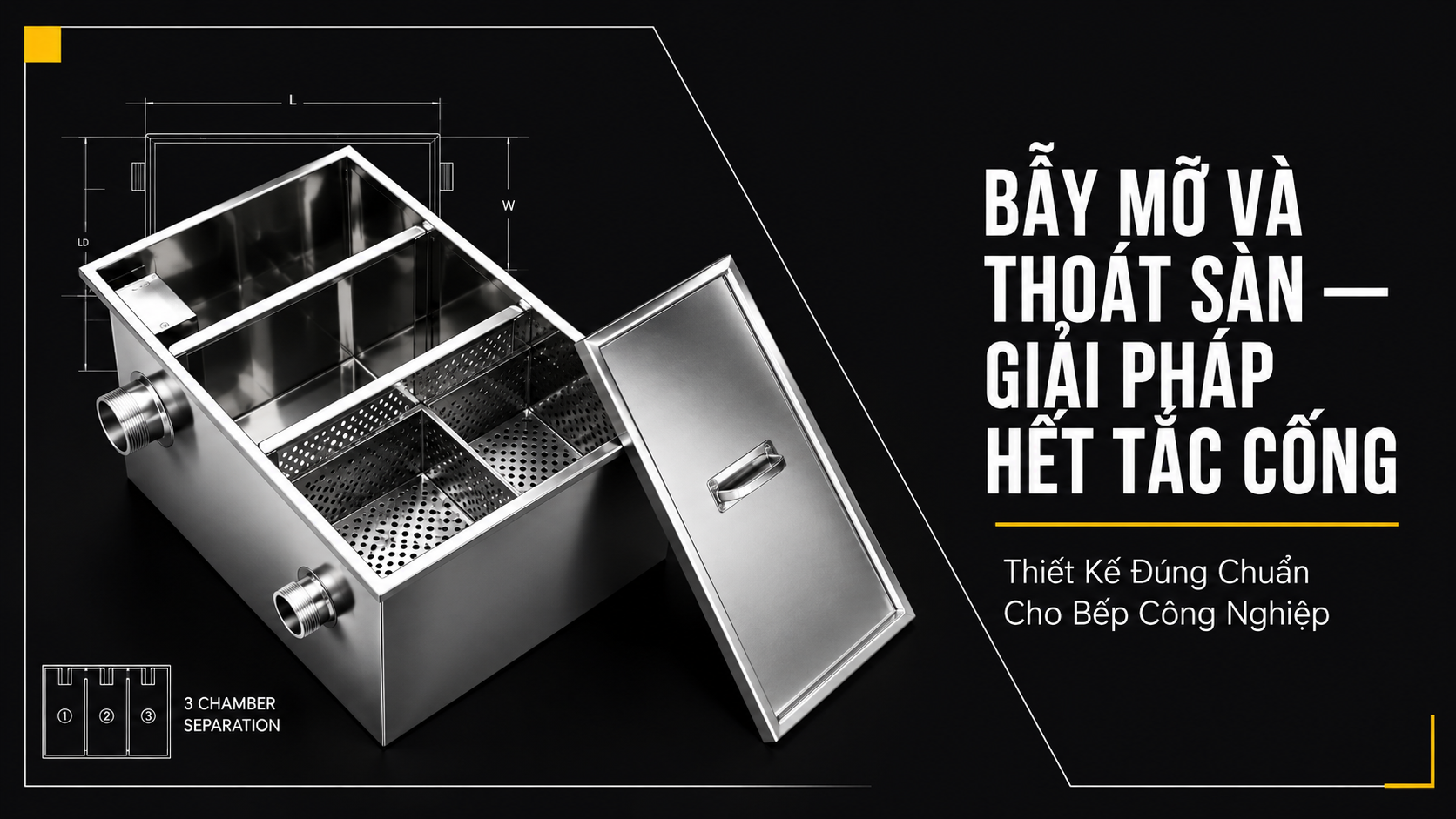
The Importance of Grease Traps and Floor Drains in Professional Commercial Kitchens
Drain clogs and foul sewer odors erupting in the middle of peak dinner rush — this is one of the most dreaded operational nightmares restaurant owners and F&B operators face, inevitably striking at the busiest, most inconvenient moments when fast fixes are near impossible.
Wastewater generated by commercial kitchens carries exceptionally high concentrations of fats, oils, and grease (FOG), along with tiny organic food particles. When this effluent travels into cold underground plumbing, temperatures drop rapidly, causing the grease to solidify and undergo saponification — chemically bonding with debris to form rock-solid masses as hard as concrete.
This phenomenon chokes off drainage pipes and triggers putrid wastewater backups onto the kitchen floor. This article provides a comprehensive technical breakdown of heavy-duty stainless steel grease traps and floor trench drain systems, covering operational fluid dynamics, capacity sizing calculations, and maintenance schedules.
1. Why Fats, Oils, and Grease Are the Leading Cause of Commercial Kitchen Drainage Clogs
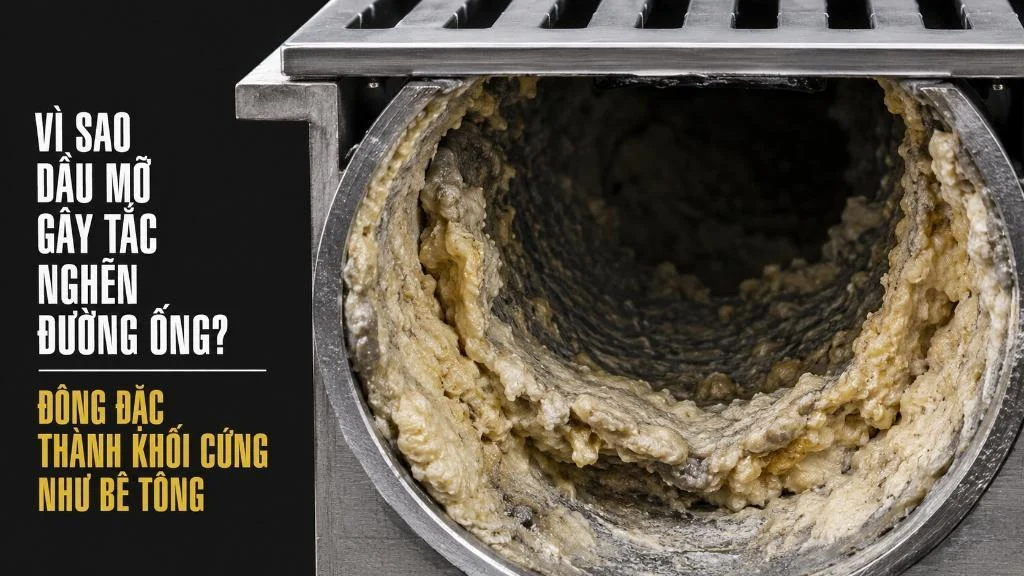
Unlike standard domestic wastewater, commercial kitchen effluent carries substantial volumes of grease in hot liquid form.
Trouble begins the moment this hot mixture leaves the prep sinks and dishwashers to enter the drainage pipes. As the water cools downstream, the grease transitions from a liquid state into a semi-solid sludge that clings tenaciously to the pipe walls. Over time, these grease coatings thicken, trapping food scraps, coffee grounds, hair, and soap curd to form stubborn calcified blockages that mechanical snaking or chemical plungers rarely resolve.
Without an effective grease interceptor installed directly at the source, all this FOG flows unchecked into the building’s municipal or sewer network. This causes severe blockages not only within the restaurant premises but across the broader municipal wastewater infrastructure — precisely why municipal utility boards strictly mandate certified grease traps before issuing food service operating permits.
2. Fluid Separation Principles of Grade 304 Stainless Steel Grease Traps
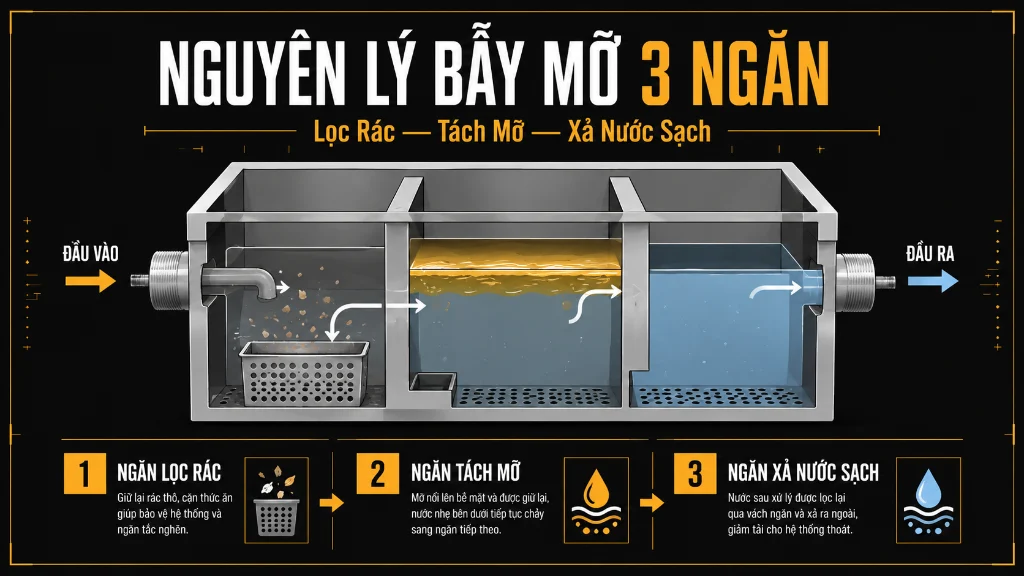
Grease interceptors operate fundamentally on Stokes’ Law governing the gravity separation of immiscible liquids with differing densities. Since animal and vegetable fats are lighter than water (with a specific gravity of roughly 0.9 g/cm³ compared to water’s 1.0 g/cm³), oil naturally floats to the surface while heavier food solids sink to the bottom.
A standard 3-compartment stainless steel grease interceptor manufactured by Saigon Horeca is engineered with hydrodynamically optimized compartments:
Compartment 1 — Coarse Solids Filtration and Kinetic Energy Dissipation: Heavy surge effluent discharging from wash sinks passes through a removable, perforated stainless steel strainer basket. The basket captures bone fragments, food peelings, rice grains, and large debris. Simultaneously, this chamber dissipates the violent velocity and kinetic energy of the incoming discharge, converting chaotic turbulent flow into smooth laminar flow.
Compartment 2 — Static Gravitational Grease Separation: This compartment features the largest internal volume to maximize hydraulic retention time (HRT). Wastewater moves through this chamber at an ultra-low velocity. Integrated internal baffles direct the water stream downward, creating quiescent hydrodynamic conditions that allow liberated grease droplets to float unimpeded, accumulating into a dense floating scum blanket at the surface.
Compartment 3 — Clean Effluent Discharge: The clarified greywater situated in the middle zone (free of both heavy sediment and floating grease) passes underneath a skimming baffle or through an inverted submerged T-pipe situated near the bottom of the chamber, safely discharging into the building’s primary sewer stack.
Why a 3-Compartment Design Outperforms Rudimentary Single-Stage Traps
Many low-cost traps on the market feature crude single- or two-compartment designs where the retention time is far too brief for oil droplets to separate before water is expelled.
A properly calculated 3-compartment interceptor with precision-engineered internal baffle spacing maximizes hydraulic retention time within a compact footprint. This internal hydrodynamic balance — rather than crude exterior box volume alone — is the definitive factor determining real-world separation efficiency.
3. Engineering Standards for Recessed Stainless Steel Trench Drains
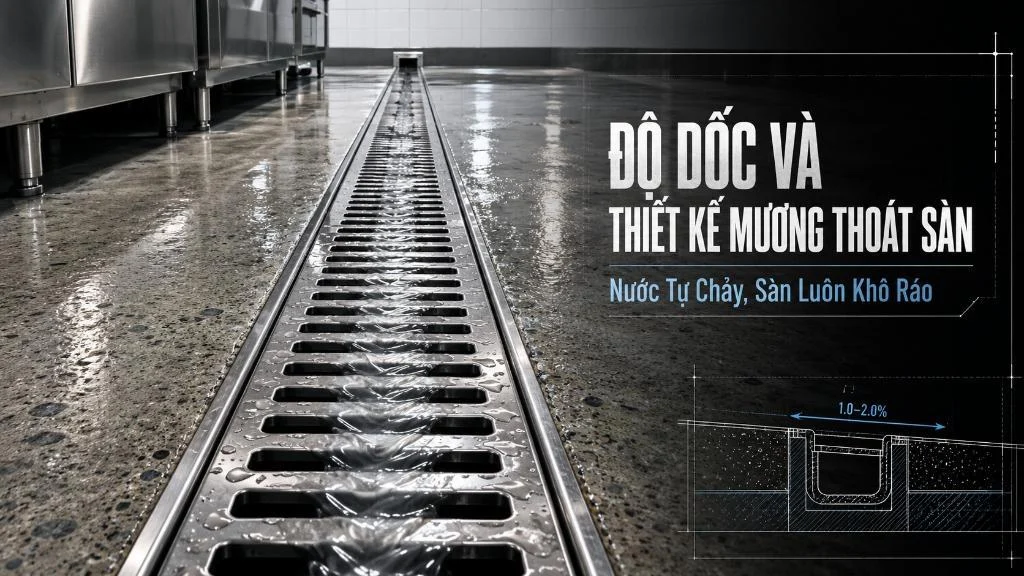
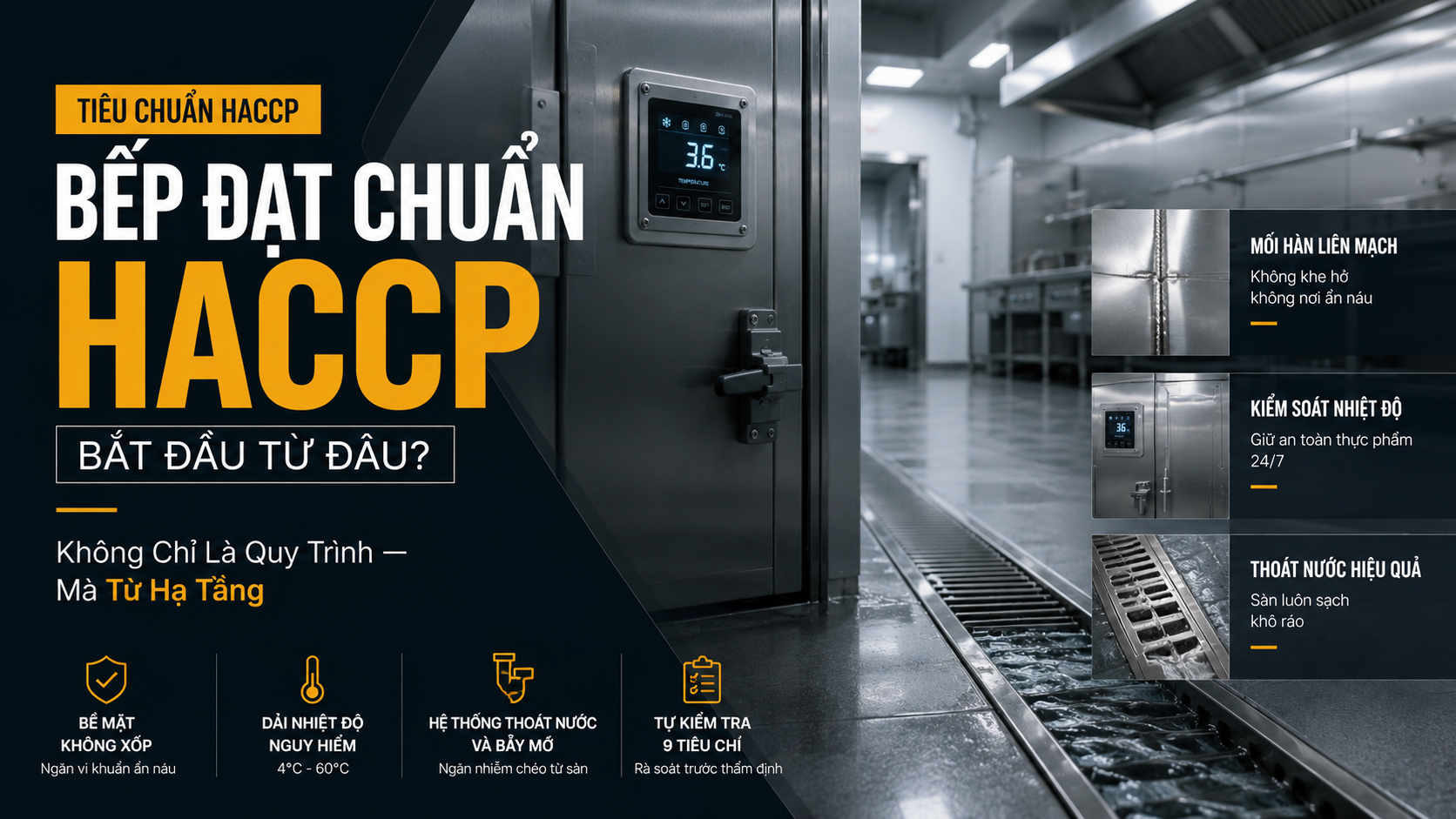
Commercial kitchens must never rely on domestic point floor drains. Their diminutive intake surface area quickly chokes on debris, loose hair, and vegetable scraps. Professional commercial kitchen design mandates continuous recessed trench drains running parallel to major wet activity zones (beneath pot sinks, prep counters, and in front of Asian and Western hot cooking lines).
Technical Fabrication Specifications for Stainless Steel Trench Drains
Material Specifications: The recessed trough and top heavy-duty grating must be constructed exclusively from food-grade AISI 304 stainless steel with a minimum thickness of 1.2 mm to 1.5 mm. This guarantees long-term resistance against aggressive floor sanitation chemicals and withstands the wheel loads of heavily laden ingredient carts.
Hydraulic Trough Slope: The bottom of the stainless trough is brake-formed into a shallow V-profile and pitched at a hydraulic gradient of 1.5% to 2.0% towards the collection basin. This built-in slope accelerates washdown water velocity, naturally sweeping settled sediment into the basin without requiring kitchen staff to constantly broom water manually.
Bell Trap Odor Barriers: At the outlet where the collection basin drains into the PVC pipe, a stainless steel bell trap assembly combined with a secondary strainer basket must be installed. The standing water seal trapped beneath the bell forms an impenetrable barrier that prevents 100% of foul sewer and methane gases from backing up into the kitchen environment.
4. Sizing Grease Traps and Trench Drains Based on Kitchen Scale
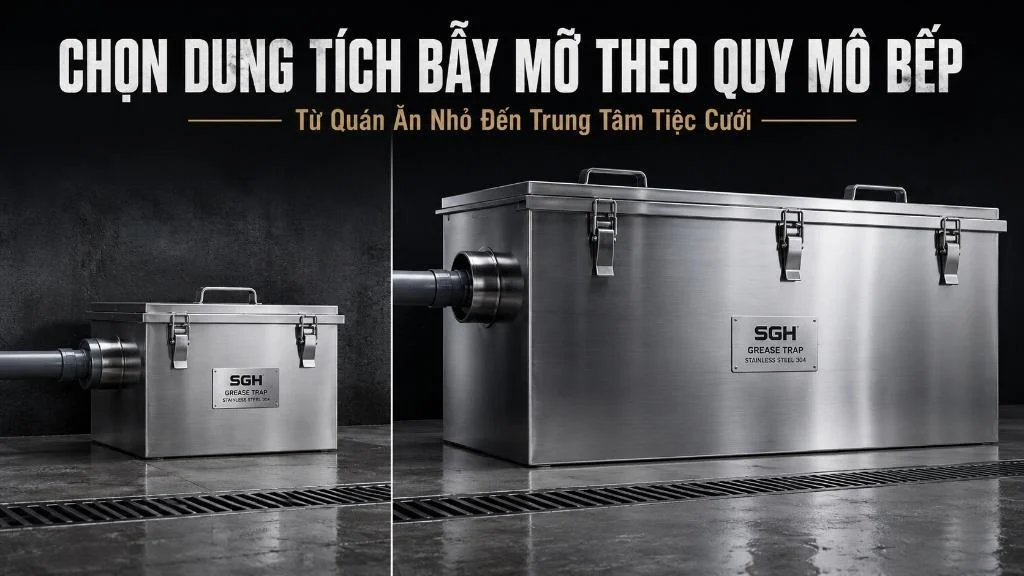
Grease trap sizing must be calibrated against the combined peak discharge flow rate of all interconnected fixtures (e.g., 2-compartment pot sinks, 3-compartment prep sinks, and commercial dishwashers).
If an interceptor is undersized, retention time is drastically cut; fast-moving effluent surges will flush floating grease straight out into the sewer line, completely defeating the purpose. Conversely, an oversized unit needlessly wastes valuable floor space and drives up initial capital expenditure.
Small Eateries & Cafes (1–2 sink compartments, under 50 meals/day): Compact point-of-use grease traps ranging from 50 to 100 liters, fitted neatly under the sink basin or recessed into a corner floor slab.
Medium Full-Service Restaurants (complete Asian/Western cooking line, 100–300 meals/day): Medium-capacity interceptors paired with continuous trench drains running along prep and dishwashing zones to handle surge discharge during peak meal periods.
Large Restaurants, Banquet Centers & Central Commissaries (hundreds to thousands of meals/day): Industrial heavy-capacity centralized grease interceptor systems, typically custom-fabricated in multi-cubic-meter underground vaults with multiple collection channels routing into a central treatment station.
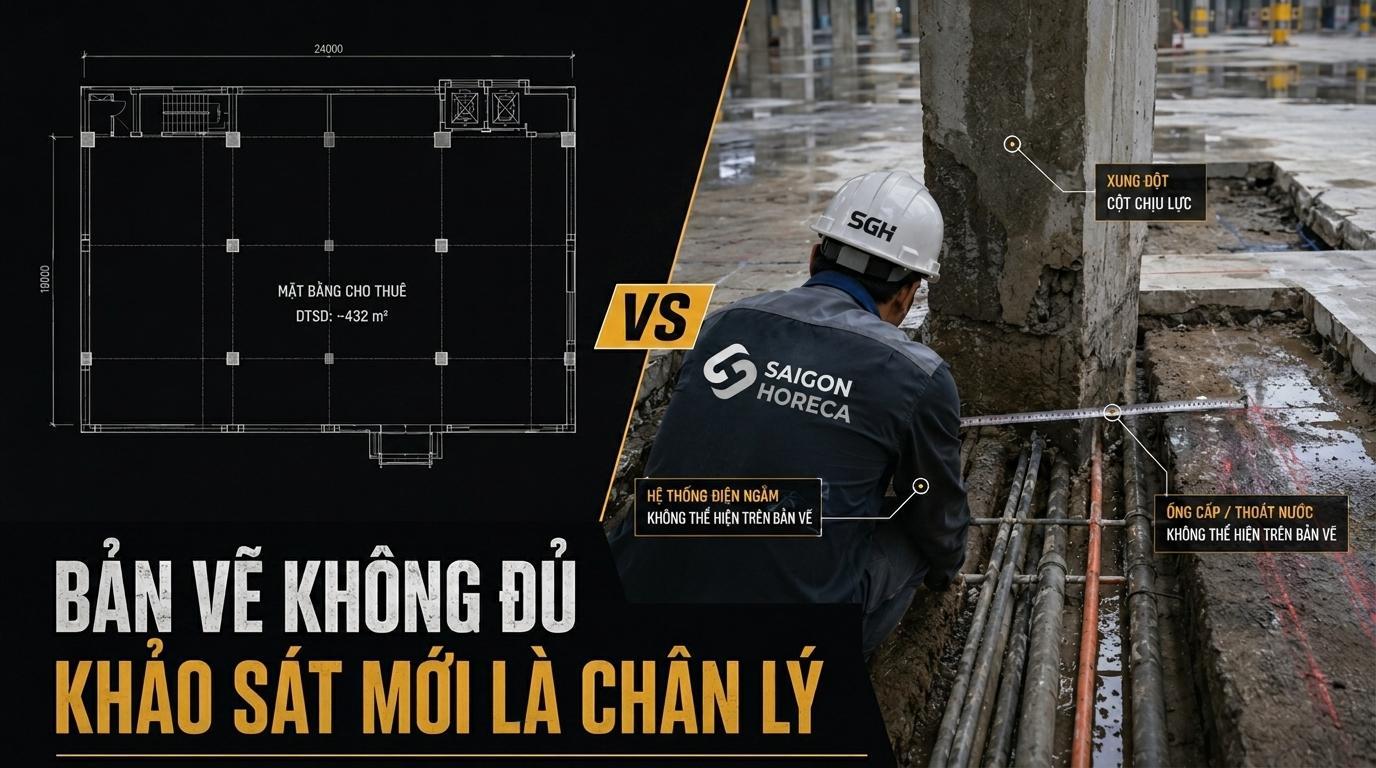
Selecting an incorrect volume — whether too small or too large — leads to recurring operational friction and cost overruns. A rigorous on-site survey evaluating realistic hydraulic loads must precede equipment purchasing rather than relying on guesswork or generic catalog models.
5. Routine Maintenance Protocols for Long-Term Drainage Reliability
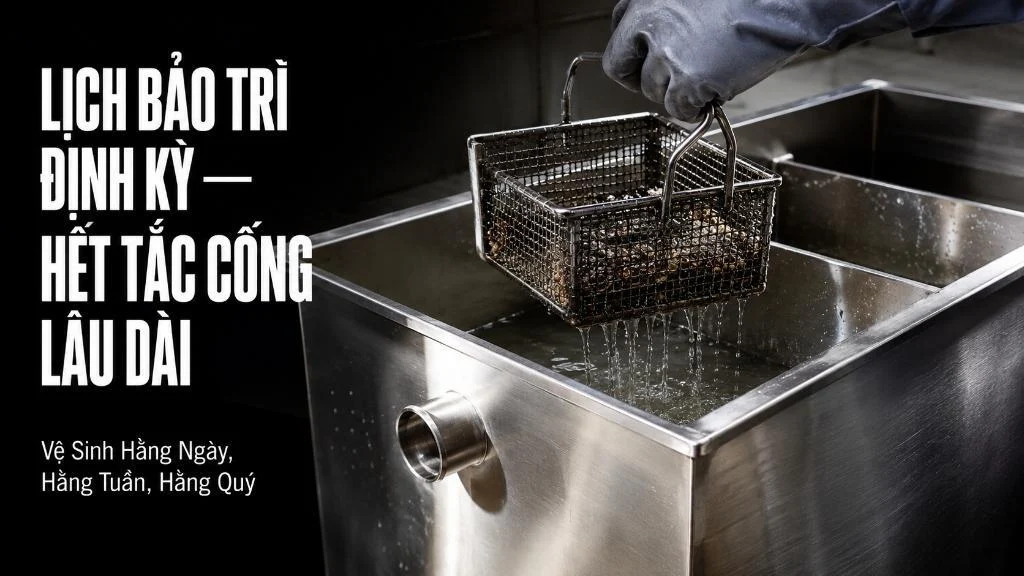
To ensure consistent drainage performance, kitchen staff must be trained on a rigorous cleaning timetable instead of reacting only when backflow emergencies occur.
Daily: Remove and empty the solid waste filter basket in Compartment 1 at the conclusion of each shift to prevent decomposing food waste from generating stench and impeding primary water intake.
Weekly: Skim off the congealed grease cap accumulated in Compartment 2 at least once weekly to prevent excessive grease hardening that restricts internal hydraulic flow paths.
Monthly: Inspect the entire floor trench drain run, verifying that gratings are free of wedged debris, hydraulic gradient flow remains unimpeded, and no standing water pools exist along the channels.
Every 3 to 6 Months: Schedule a complete professional pump-out service to vacuum accumulated bottom sludge from Compartments 1 and 2, restoring full working volume and preventing settled solids from compacting.
Neglecting scheduled maintenance is the most common reason why even an expertly engineered grease interceptor eventually suffers severe clogs. The failure rarely stems from equipment design; it stems from lax daily operational discipline.
6. Frequently Asked Questions: Commercial Kitchen Grease Traps & Drainage
Are small commercial kitchens legally required to install grease traps, or only large restaurants?
Regardless of operational footprint, any food preparation facility generating grease-laden wastewater should install an interceptor sized to its actual discharge volume. The only variable is capacity and configuration complexity, not whether one is needed. Small cafes and bistros face identical pipe-clogging risks if this vital infrastructure is omitted.
Why does my grease trap still clog shortly after being newly installed?
The most common culprit is choosing an undersized capacity relative to real peak discharge, or neglecting regular cleaning schedules outlined in Section 5. Another frequent error is incorrect drainage pipe grading leading into or out of the trap, preventing wastewater from reaching the minimum self-cleansing velocity required to keep solids suspended.
Can we fabricate grease traps from plastic or composite materials to cut costs?
While plastic or composite alternatives cost less upfront, they often fail to withstand the continuous hot wastewater discharges characteristic of commercial dishwashing, resulting in thermal deformation, embrittlement, and cracking over time. Grade 304 stainless steel remains the premier, sustainable choice due to its high thermal tolerance, chemical resistance against commercial degreasers, and exceptional lifespan.
Saigon Horeca engineers high-performance stainless steel grease interceptors ranging from compact 50-liter point-of-use units to multi-cubic-meter central vault systems for wedding convention halls. Our engineering team conducts thorough site surveys to calculate accurate hydraulic discharge loads from day one, preventing expensive retrofits later.
7. Legal Compliance and Environmental Stewardship in FOG Management
Beyond plumbing blockages that cripple daily service, discharging untreated oily wastewater involves serious regulatory and ecological ramifications that many F&B investors overlook.
Grease buildup in public utility mains causes extensive municipal blockages and can prompt severe localized street flooding during tropical downpours when numerous area eateries dump untreated FOG into shared storm lines.
In many jurisdictions, environmental agencies and commercial licensing authorities require food service establishments to present certified wastewater treatment compliance before issuing food hygiene permits and business licenses, verified during periodic regulatory inspections.
Investing in a certified stainless grease interceptor from the outset is not merely a plumbing safeguard; it represents an essential legal compliance asset that safeguards continuous commercial operations and eliminates the threat of heavy fines or forced closures.
8. Proven Field Experience: Drainage Installations Across Saigon Horeca Projects
With over 30 executed commercial kitchen installations, including Michelin Guide establishments such as Sol Kitchen, Yuzu Omakase, Bambino SuperClub, and Little Bear, Saigon Horeca has observed that floor drainage and grease management are frequently underbudgeted during initial planning phases.
Yet, they cause the highest proportion of crippling operational shutdowns when engineered incorrectly — precisely because drainage is an “invisible” sub-floor infrastructure that goes unnoticed until sewage overflows into the dining or cooking zones during a bustling dinner service.
Field experience yields an undeniable lesson: the upfront capital required to implement standard-compliant grease interceptors and trench drains accounts for an insignificant percentage of overall kitchen equipment budgets.
However, it completely eliminates catastrophic business interruptions caused by sewer blockages — an emergency that forces kitchens to shut down mid-service, resulting in devastating revenue losses and lasting brand reputational damage when patron dining rooms are packed.
9. Positioning Grease Traps and Trench Drains Within a One-Way Kitchen Workflow
Grease interceptors and drainage channels should never be handled as isolated mechanical fixtures; they must be seamlessly integrated into the architectural one-way (HACCP linear flow) kitchen layout from the earliest drafting stages.
Grease trap placement and trench drain gradients must synchronize with wastewater generation points across functional zones: prep stations, primary hot cooking lines, and dishwashing areas produce the highest FOG volumes. Trench drains should flank these zones, channeling effluent smoothly toward designated central trap locations.
A frequent design blunder is placing interceptors excessively far from high-discharge fixtures, creating extended pipe runs that invite grease to cool, congeal, and solidify along interior pipe walls before ever reaching the trap.
Optimal engineering mandates positioning grease interceptors as close to high-FOG generation sources as possible while preserving convenient, unobstructed access for periodic pumping without disrupting staff workflow or requiring heavy equipment relocation.
10. Investing Right from Day One: The Long-Term Return on Capital
Much like selecting high-grade stainless steel fabrication or properly engineered exhaust ventilation, cutting corners on drainage and grease management inevitably incurs exponentially higher downstream costs.
These downstream expenses include emergency plumbing callouts, expensive floor demolition to replace substandard piping, and catastrophic revenue losses incurred when dining rooms are forced to close during peak operations.
Saigon Horeca urges restaurant investors to treat grease management and drainage infrastructure as an indispensable core component of initial master planning rather than treating it as an afterthought during late-stage civil construction.
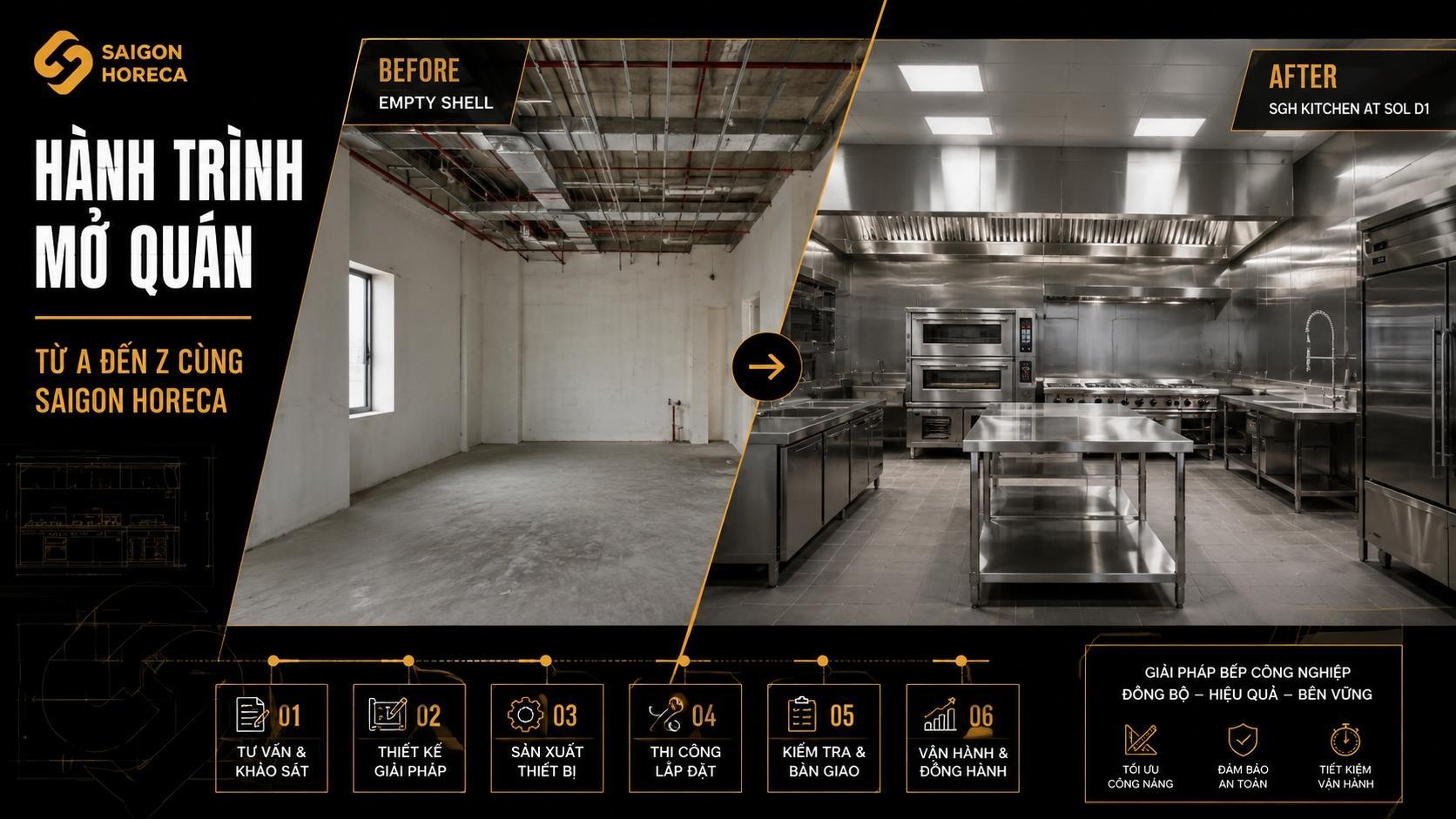
This is why Saigon Horeca partners with hospitality operators across every phase — from initial site surveys and hydraulic flow calculations to turnkey fabrication, installation, and commissioning — guaranteeing that every technical detail, even the “unseen” sub-floor utilities, operates in flawless harmony with the entire facility.
#saigonhoreca #greasetrap #kitchenfloordrain #stainlesssteeldesign #kitchensetup
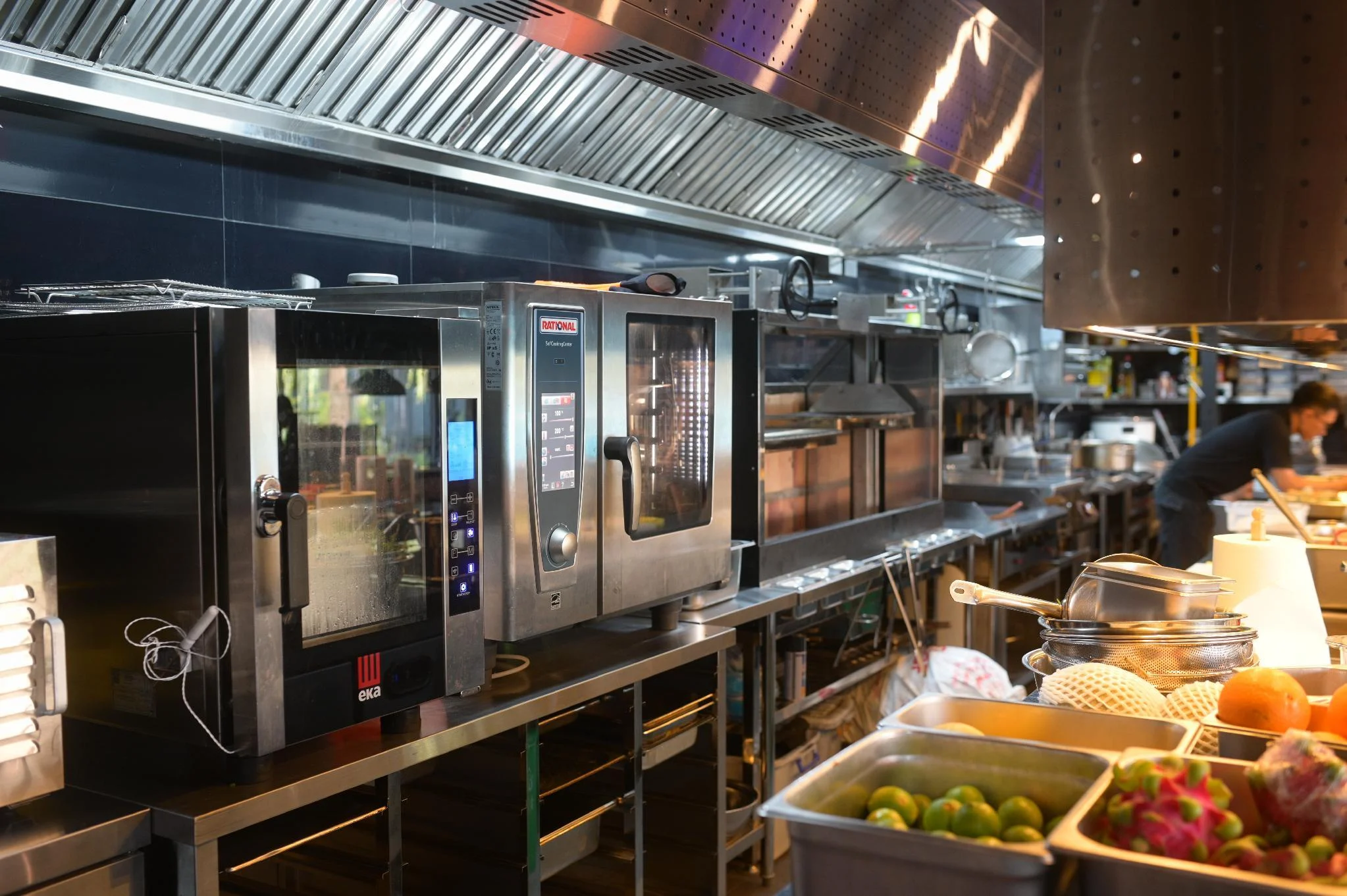
Project Showcase
 Facebook
 Zalo
Zalo