Selecting commercial kitchen equipment materials is a strategic decision that directly impacts operational efficiency, food hygiene and safety standards (HACCP), and the overall financial equation for every F&B investor. Among the most widely used materials, the rivalry between Grade 304 stainless steel (austenitic stainless steel group) and Grade 201 stainless steel has always been at the center of deliberation. This article delivers an in-depth analysis ranging from micro-metallurgical structures to real-world performance and Return on Investment (ROI) calculations, empowering restaurateurs to make the most informed decision.
1. Micro-Metallurgical Structure: The Origin of Performance Discrepancies
To understand why these two stainless steel grades exhibit such substantial disparities in durability and cost, we must delve into their underlying chemical composition. Both 304 and 201 stainless steels belong to the austenitic family, meaning they possess a face-centered cubic (FCC) crystal lattice structure that maintains excellent toughness across both extreme high and low temperatures.
Detailed Chemical Elemental Composition:
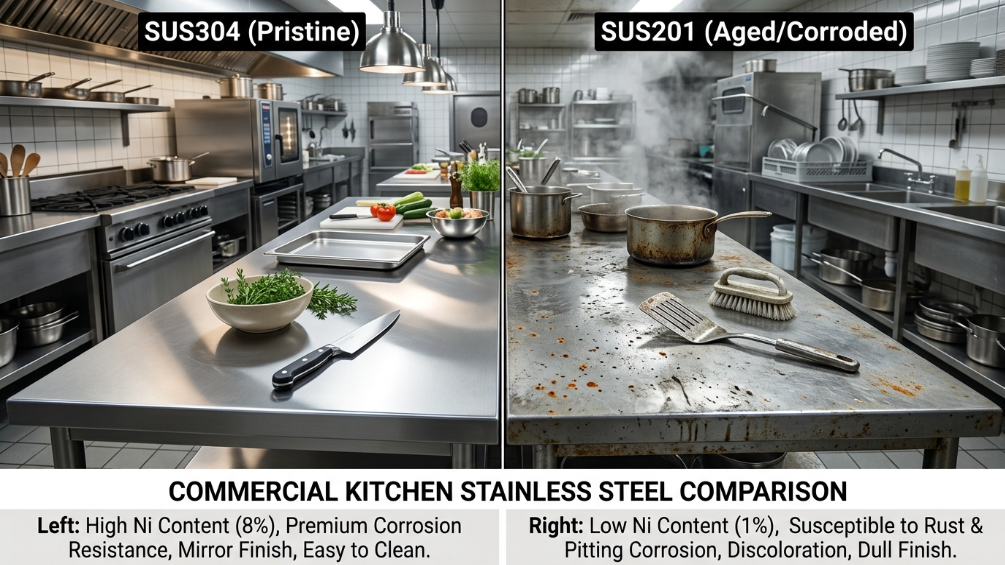
- 304 Stainless Steel (SUS304 or 18/8 grade): Contains a minimum of 18% Chromium (Chromium) and 8% Nickel (Nickel).
- 201 Stainless Steel (SUS201 grade): Contains approximately 16% – 18% Chromium, but only 3.5% – 5.5% Nickel. To compensate for the reduced nickel content while preserving the austenitic phase, manufacturers substitute it with 5.5% – 7.5% Manganese (Manganese) and a small addition of nitrogen.
Roles of Key Elements in Kitchen Environments:
- Chromium (Cr): Forms an ultra-thin, highly stable passive oxide layer on the steel surface (Chromium Oxide). This passive film self-heals when scratched, isolating the underlying iron core from direct oxygen contact and preventing rust.
- Nickel (Ni): An expensive alloying element that stabilizes the austenitic structure, substantially enhancing ductility, formability, and, most critically, chemical corrosion resistance in harsh environments exposed to mild acids or chlorides (salts).
- Manganese (Mn): Increases surface hardness and tensile strength but markedly diminishes deep-draw formability and overall chemical corrosion resistance.
2. Real-World Performance Comparison in Commercial Kitchen Environments
A commercial restaurant kitchen is one of the most demanding operational environments for metals, subjecting them to continuous high humidity, severe temperature fluctuations, aggressive cleaning chemicals, and corrosive agents such as table salts, fish sauce, and organic acids from lemons, vinegar, and tomatoes.
Chemical Corrosion Resistance and Pitting Corrosion: During daily cooking operations, contact with fish sauce, salt, and seasonings is inevitable. Chloride ions (Cl-) in salt are the number one adversary of stainless steel. Due to its elevated nickel content, Grade 304 exhibits outstanding resistance to localized pitting corrosion. The chromium-nickel protective oxide film effectively prevents chloride penetration. In contrast, Grade 201 features low nickel concentrations, rendering its protective passive film susceptible to rapid breakdown. When chloride ions breach the 201 surface, they trigger localized pitting corrosion. Microscopic pinholes form on the equipment surface, which gradually expand into dark yellowish-brown rust blooms. This not only degrades aesthetics but also harbors hazardous bacterial colonies, severely violating HACCP and food safety regulations.
Surface Hardness vs. Physical Brittleness: Manganese makes Grade 201 approximately 10-15% harder than Grade 304 on the Brinell hardness scale. However, this higher hardness comes at the expense of increased brittleness. In kitchen equipment fabrication, Grade 304 provides superior ductility, allowing seamless CNC bending, crisp edge forming, and deep-drawn monoblock pressing for sink bowls without micro-cracking. Its high elasticity also absorbs heavy culinary impacts. Conversely, Grade 201’s higher brittleness tends to produce residual stresses and micro-fractures along tight CNC bend radii. Over time, under thermal cycling in hot kitchen lines, these micro-cracks propagate and lead to structural failure.
3. Financial Analysis and Return on Investment (ROI)
To provide commercial investors with a practical perspective on capital expenditure versus operating expenditure, let us examine the comparative Total Cost of Ownership (TCO) breakdown for a standard 1,500 mm commercial stainless steel worktable.
| Evaluation Criteria | Grade 304 Equipment | Grade 201 Equipment |
|---|---|---|
| Initial Purchase Cost | 5,500,000 VND | 4,000,000 VND |
| Expected Lifespan | 10 – 15 years (or more) | 2 – 3 years (in hot/humid kitchens) |
| Replacements over 10 Years | 0 times | 3 times |
| Total Replacement Cost over 10 Years | 5,500,000 VND | 16,000,000 VND (excluding inflation) |
| Maintenance & Scrubbing Labor Cost | Low (plain water & mild dish detergent) | High (specialized rust-removing chemicals) |
| Food Safety & Contamination Risk | None | Very High (bacteria traps in pitted/rusted surfaces) |
| Total Cost of Ownership (TCO) | 5,500,000 VND | 18,000,000+ VND |
As illustrated in the analysis table, although the upfront capital investment for Grade 304 is approximately 35-40% higher than Grade 201, the long-term Total Cost of Ownership for Grade 201 ends up being over 3 times higher due to frequent equipment turnover. This excludes the substantial opportunity cost incurred when a restaurant must temporarily shut down kitchen lines for renovation and equipment replacement.
https://saigonhoreca.vn/wp-content/uploads/2026/07/inox-304-vs-inox-201-giai-ma-vat-lieu-bep-nha-hang-duoi-goc-do-ky-thuat-luyen-kim-va-tai-chinh-dai-han-2.png
4. Engineering & Layout Recommendations from Saigon Horeca
Backed by years of engineering and executing hundreds of industrial kitchen systems under stringent hygiene benchmarks, Saigon Horeca recommends the following material zoning strategy:
Mandatory 100% Grade 304 Zones:
- Raw food prep tables (direct contact with meat, seafood, poultry, vegetables).
- Sink wash systems, dishwashing stations, and ingredient washing basins.
- Hot holding tables, chef plating lines, and cooked food staging counters.
- Direct gas/electric cooking equipment: Asian wok ranges, European burner stoves, commercial rice steamers, and stockpot boiling kettles.
Zones where Grade 201 May Be Balanced to Optimize Budgets:
- Wall-mounted shelving units inside dry storage rooms.
- Under-structure legs or sub-frame bracing positioned deep beneath tables without direct water and chemical exposure.
- Clean dish and tray transport trolleys operating in cold rooms or dining front-of-house areas.
Saigon Horeca is dedicated to transparent material consulting, employing precision CNC press-braking technology and refined argon-shielded TIG welding to maximize long-term operational efficiency and asset value for your commercial project.
 Facebook
 Zalo
Zalo